Table of Contents
- The Test
- Where AI UGC Wins
- Where Real Influencers Still Win
- What the Data Actually Tells You
- So Which One Should You Actually Use?
- FAQ
- TL;DR
(This is a manual TOC in markdown link format. Once Easy Table of Contents is installed and active, it’ll auto-generate one from your H2s. You can delete this block then, or leave it as a fallback.)
Brands are quietly running AI-generated UGC ads next to real influencer content right now. Same feed, same campaign, same budget line. And most of them aren’t telling anyone which is which.
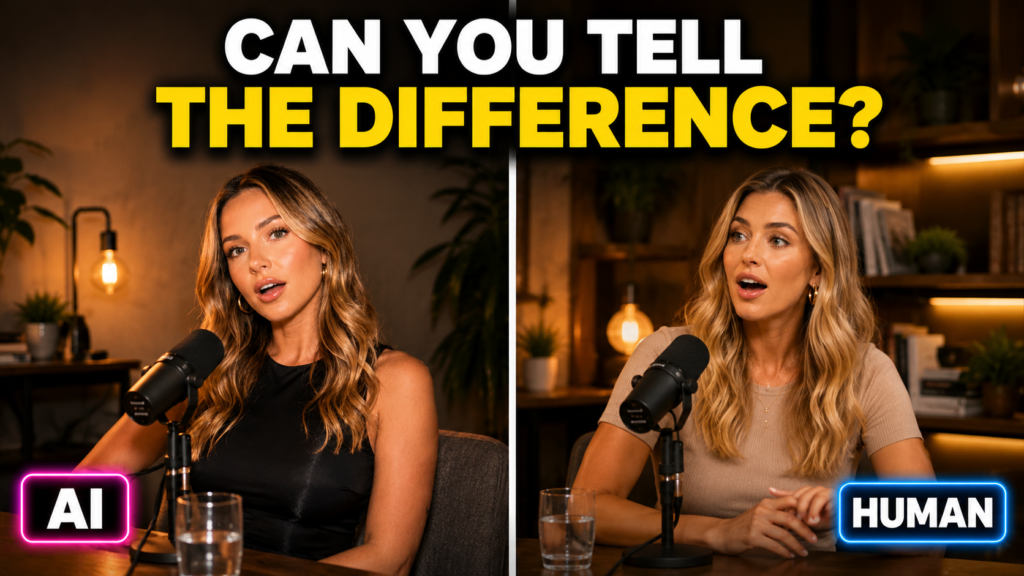
So we did what nobody in this industry wants to admit they’re doing: we tested them side by side. Same product, same hook, same offer. One version shot with a real creator. One version built entirely with AI, made the same way <a href=”/”>we build AI UGC ads for brands every day</a>. Here’s what actually happened, minus the sales pitch.

The Test
We ran two versions of the same ad concept: a simple product-in-hand testimonial style video, the kind that dominates TikTok and Reels right now. Same script beats, same call to action, same $ spend behind each for two weeks.
A real micro-influencer filmed one. The other was fully AI-generated: script, voice, face, everything. Both went live on the same platforms at the same time. No cherry-picking, no “best case” AI example. Just a fair fight.
Where AI UGC Wins
Let’s start with the obvious stuff, because it’s obvious for a reason:
- Speed. The AI version was ready in hours. The influencer version took almost two weeks of scheduling, briefing, filming, and revisions.
- Scale. We generated 10 variations of the AI ad, different hooks, different pacing, for close to what one influencer deal cost. Try doing that with a human creator’s calendar.
- Control. No brand-safety surprises. No creator going off-script, posting something questionable, or ghosting mid-campaign.
But it’s not flawless. On close inspection, the AI version still had that faint “almost real” quality, the kind of thing your eye catches before your brain can explain why. Most scroll-speed viewers won’t notice. A sharp-eyed few will.

Where Real Influencers Still Win
This is the part a lot of AI companies don’t want to say out loud, so we will.
- Trust. People follow a creator because they feel like they know them. That parasocial pull is not something AI has fully replicated yet.
- The algorithm still has a soft spot for real accounts. Some platforms subtly favor content from established creator profiles over brand-run or synthetic accounts.
- Imperfection sells. The shaky camera, the awkward pause, the “oops let me redo that” energy. That’s the stuff that makes UGC feel like UGC in the first place. AI is getting better at faking it. It’s not fully there.
If your product lives or dies on trust (skincare, supplements, anything health-adjacent), that gap matters more than it does for, say, a phone case.
What the Data Actually Tells You
Here’s the part everyone skips in their “AI vs influencer” content: nobody’s numbers transfer to your account. CPMs, click-through, save rate, all of it swings hard depending on your niche, your offer, and which platform’s algorithm is having a mood that week. Anyone posting a clean “AI beat influencers by X%” chart is either cherry-picking their best run or straight-up making it up.
What held true across our test, and what tends to hold true in general: AI UGC’s advantage shows up early, in how fast you can test hooks and how many variations you can afford to throw at the algorithm. The influencer’s advantage shows up later, in how the audience actually responds once they know a real person is behind it.
So instead of chasing a universal stat, run your own head-to-head before you commit budget either way. If you want to see what that actually costs, <a href=”/pricing/”>check out our pricing</a>. Most brands start with a test batch before scaling.
So Which One Should You Actually Use?
Here’s our actual take, not a fence-sit: use AI UGC to test fast and find your winning hooks. Once you know what works, bring in a real creator to build the flagship version, the one that runs at scale and carries the brand’s trust.
AI is your speed layer. Humans are your trust layer. Pretending you only need one is how you either burn your budget guessing, or burn two weeks waiting on a single creator to find out your hook didn’t work anyway.
FAQ
Is AI UGC as effective as real influencer content? It depends on the goal. For fast testing and scale, AI UGC often performs just as well or better. For deep trust and long-term engagement, real influencers still have an edge.
What are the best AI UGC tools in 2026? The space is moving fast, with new tools improving realism and voice quality every few months. The right pick depends on your budget, turnaround needs, and how polished you need the final output to look.
Can AI UGC ads go viral? Yes. Virality depends more on the hook and pacing than on who, or what, is in front of the camera. AI-generated ads have gone viral without viewers realizing they weren’t real.
TL;DR
- AI UGC wins on speed, cost, and scale. Great for testing hooks fast.
- Real influencers win on trust and engagement depth. Better for flagship campaigns.
- The smartest brands aren’t choosing one. They’re using AI to find what works, then using humans to scale the winner.
- Anyone telling you it’s a clean win for either side isn’t being straight with you.
Want more breakdowns like this? Check out the rest of our <a href=”/blog”>AI UGC Ads blog</a> for more head-to-head tests and no-fluff takes.